
← 返回游戏目录
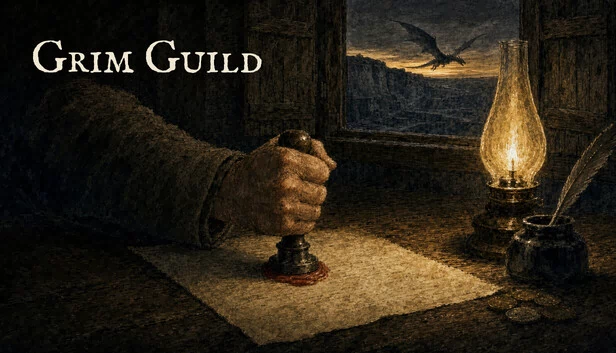
Your grandfather Karl left you an adventurers' guild and alehouse at the edge of Eldenmarch: a counter, a board, a bar, a hole in the roof, and a book full of the things he knew.
The road, the fen and the old quarry are full of things that take sheep, and sometimes people. Thunderboars and dire wolves, cave bears and wyverns, giant spiders, great worms under the fields, goblins, orcs and trolls, and once a year something with a name. The petitioner only knows that the stock is going missing. Send somebody to look first, and you will know what it is, and what it will take.
In the morning, whoever has come to the counter tells you what they need. By day you pin work to the board and spend your three errands for the week: look at a job before you post it, ask around about a group, or take the cart's haul into town while it still fetches a price. In the evening you stand at the door, and whoever is due back comes in. Or does not. At night you pour at the bar. Upstairs, there is the book, and the week's sums.
Every job goes out on a sheet in your hand. How much goes to them. How plainly you write the danger. Whether they may turn back. The sheet also says what the hall pays if it goes wrong. Nobody makes you tell the truth, and until somebody has looked, the board only knows what the petitioner said.
The groups on your bench read the sheet and decide whether to go. Write the danger plainly and grant the right to turn back, and they come to trust the hall. Leave the warning off, and the report that comes through the door will tell you what it cost, in words, because the fight is never shown. Every death can be traced back to a warning somebody chose not to write. A week somebody does not come back, the room goes quiet, and a quiet room does not sign. The churchyard helps, a little.
Ale takes a week at the least. Brew before the cellar runs dry.
A year runs from spring to winter and the old quarry at the end of it. It ends one of six ways. However it ends, it is bound into a book with your name on the spine, to read again, print at A5, or send to someone else.
Keep your hall in a town with up to a hundred others. Every hall starts in the town's first week and plays at its own pace. The halls ahead leave their marks on the weeks you have not reached: their dead are stones in your churchyard from the week they fell, their troubles are talk at your bar, and what they lost in the fens can turn up in your hands with a note of whose it was. Stand at another hall's stone and that hall hears of it. A town can last one year or fifty. Open it in a friends-only Steam lobby and invite friends from the overlay: no address, no port. Your game keeps the town, and your friends play on while it is closed.
The silver in the box is spent by the end of every year. The hall's name is what carries. A high name brings better hands to the door and bigger work to the board; a low one brings whoever has nowhere else to go. Some weeks you bet: brew winter ale for a festival that may not happen, lay in food against a famine that may not come, send someone after a creature that has a name. War, plague and flood come when they come. What you do afterwards is still yours. In a long town the keeper grows old, and after the twelfth year the hall passes to someone who once came in through the door.
No fight to play and no gore on screen. The deaths are in the reports, and they are yours.
GAME PROFILE
Grim GuildGrim Guild
You never go on the adventure. You only decide who does. Your grandfather Karl left you an adventurers' guild and alehouse at the edge of Eldenmarch: a counter, a board, a bar, a hole in the roof, and a book full of the things he knew. What is out there The road, the fen and the old quarry are full of things that take…
You never go on the adventure. You only decide who does.
Your grandfather Karl left you an adventurers' guild and alehouse at the edge of Eldenmarch: a counter, a board, a bar, a hole in the roof, and a book full of the things he knew.
What is out there
The road, the fen and the old quarry are full of things that take sheep, and sometimes people. Thunderboars and dire wolves, cave bears and wyverns, giant spiders, great worms under the fields, goblins, orcs and trolls, and once a year something with a name. The petitioner only knows that the stock is going missing. Send somebody to look first, and you will know what it is, and what it will take.
A week
In the morning, whoever has come to the counter tells you what they need. By day you pin work to the board and spend your three errands for the week: look at a job before you post it, ask around about a group, or take the cart's haul into town while it still fetches a price. In the evening you stand at the door, and whoever is due back comes in. Or does not. At night you pour at the bar. Upstairs, there is the book, and the week's sums.
The sheet you write
Every job goes out on a sheet in your hand. How much goes to them. How plainly you write the danger. Whether they may turn back. The sheet also says what the hall pays if it goes wrong. Nobody makes you tell the truth, and until somebody has looked, the board only knows what the petitioner said.
The people who sign it
The groups on your bench read the sheet and decide whether to go. Write the danger plainly and grant the right to turn back, and they come to trust the hall. Leave the warning off, and the report that comes through the door will tell you what it cost, in words, because the fight is never shown. Every death can be traced back to a warning somebody chose not to write. A week somebody does not come back, the room goes quiet, and a quiet room does not sign. The churchyard helps, a little.
Ale takes a week at the least. Brew before the cellar runs dry.
The year, bound
A year runs from spring to winter and the old quarry at the end of it. It ends one of six ways. However it ends, it is bound into a book with your name on the spine, to read again, print at A5, or send to someone else.
A town nobody waits for
Keep your hall in a town with up to a hundred others. Every hall starts in the town's first week and plays at its own pace. The halls ahead leave their marks on the weeks you have not reached: their dead are stones in your churchyard from the week they fell, their troubles are talk at your bar, and what they lost in the fens can turn up in your hands with a note of whose it was. Stand at another hall's stone and that hall hears of it. A town can last one year or fifty. Open it in a friends-only Steam lobby and invite friends from the overlay: no address, no port. Your game keeps the town, and your friends play on while it is closed.
The name, and who comes after you
The silver in the box is spent by the end of every year. The hall's name is what carries. A high name brings better hands to the door and bigger work to the board; a low one brings whoever has nowhere else to go. Some weeks you bet: brew winter ale for a festival that may not happen, lay in food against a famine that may not come, send someone after a creature that has a name. War, plague and flood come when they come. What you do afterwards is still yours. In a long town the keeper grows old, and after the twelfth year the hall passes to someone who once came in through the door.
No fight to play and no gore on screen. The deaths are in the reports, and they are yours.
linuxWindows测试版本
CHEATS
游戏修改项
当前没有可用修改项
您仍可浏览游戏资料;如后续支持修改器,修改项会显示在这里。
DISCOVER MORE




评论