The city is under the rule of the Crown of Aragon and the people are divided.
Agnese Tola is forcibly brought back to the city she fled after the death of her father, who was executed as a conspirator. Her family name, tied to the resistance against Aragonese rule, makes her too useful to be ignored.
Forced to gather information for the Aragonese viceroy, Agnese finds herself caught in a conflict between the Crown, the House of Doria, and the families of Sassari who oppose their rule. It will be up to the player to decide whom to trust, what information to share, what to conceal, and which balance of power to support.
In Su Nomine: Sassari 1349, conversations do more than simply tell the story.
Listen, investigate, and gather information through quests and exploration. When the time comes to report what you have discovered, you can tell the truth, lie, or omit important details.
Your answers influence the trust of different factions, alter future dialogue and opportunities, and ultimately shape the fate of the city and its inhabitants.
The Aragonese, the Doria, and the citizens of Sassari pursue conflicting goals.
Supporting one faction may mean condemning another. Saving someone may mean leaving someone else to their fate. Information withheld today may resurface when it is already too late.
The decisions you make persist throughout the story and help determine relationships, events, and how the story ultimately unfolds.
Su Nomine: Sassari 1349 is built upon historical research into medieval Sardinia and 14th-century Sassari.
The reconstruction of the city, its buildings, daily life, material culture, and political dynamics is being developed with the support of scholars and academics, drawing on historical sources, documentation, and specialist knowledge.
Historical figures, documented conflicts, and events from medieval Sardinia intertwine with the story of Agnese Tola. The aim is to recreate a believable narrative world in which architecture, religion, politics, and social relationships continuously shape the story and the player's decisions.
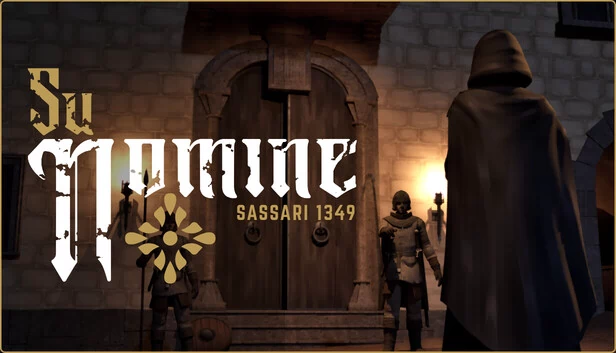
The Sassari of 1349 comes to life through a stylised, painterly 3D aesthetic, with realistic proportions, weathered materials, and a cold, earthy, desaturated colour palette.
Rain, wet stone, mud, wood, iron, and sparse touches of colour help portray a city shaped by political tension, faith, and uncertainty.

%22%2F%3E%0A%20%20%3Crect%20width%3D%221200%22%20height%3D%22800%22%20fill%3D%22url(%23glow)%22%2F%3E%0A%20%20%3Cg%20fill%3D%22none%22%20stroke%3D%22%23b9ecff%22%20stroke-linecap%3D%22round%22%20stroke-linejoin%3D%22round%22%20stroke-width%3D%2224%22%20opacity%3D%220.78%22%3E%0A%20%20%20%20%3Cpath%20d%3D%22M382%20310c-58%200-99%2034-116%2094l-47%20164c-18%2064%2049%20109%2098%2065l71-64h424l71%2064c49%2044%20116-1%2098-65l-47-164c-17-60-58-94-116-94H382Z%22%2F%3E%0A%20%20%20%20%3Cpath%20d%3D%22M360%20442h116M418%20384v116%22%2F%3E%0A%20%20%20%20%3Ccircle%20cx%3D%22786%22%20cy%3D%22420%22%20r%3D%2218%22%2F%3E%0A%20%20%20%20%3Ccircle%20cx%3D%22858%22%20cy%3D%22482%22%20r%3D%2218%22%2F%3E%0A%20%20%3C%2Fg%3E%0A%20%20%3Cpath%20d%3D%22M250%20690h700%22%20stroke%3D%22%234bd8ff%22%20stroke-linecap%3D%22round%22%20stroke-width%3D%224%22%20opacity%3D%220.28%22%2F%3E%0A%3C%2Fsvg%3E)


评论