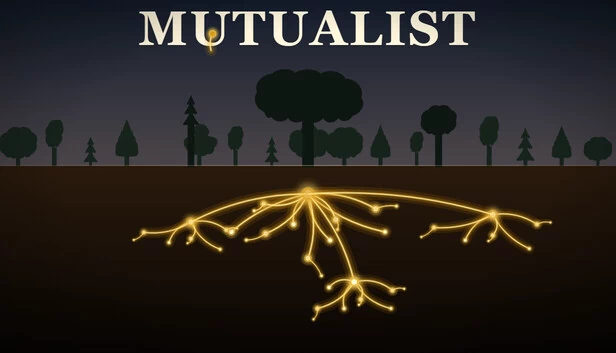
A forest is not a collection of trees. It is a market.
Under every forest floor runs a fungal network that moves sugar, phosphorus and water between roots — between species, between generations, between the dying and the young. Mutualist is a game about being that network.
You start with a single tree and almost nothing to spend. You connect a second, and the two begin trading. Carbon flows to what is growing, phosphorus to what is spreading, water to what is thirsty. Then a beetle finds your bark, a frost arrives early, and something under the soil starts asking for a share.
Grow, then let go. When a forest has given what it can, you sporulate: the trees release their spores, the grove resets, and Mycelia carries forward into the next forest as permanent memory. 183 Grove upgrades deep, the network stops being something you tend and becomes something that tends itself — and that is when the game asks whether you are willing to lose a forest on purpose to get something older in return.
Then it goes further down. Beyond sporulation lies petrification: whole eras of forest compressed into stone, stratum on stratum, each one a run you actually played. There is a bottom to that stack, and reaching it takes something the game does not explain in advance.
What you actually do
• Route four resources — Carbon, Phosphorus, Water and Spores — through a network you draw yourself, tree by tree.
• Choose species for their trades, not their stats. Oak banks carbon. Birch pulses. Pine holds water. A Mother Tree feeds its neighbours. Graft two together and get something that was not in the list.
• Bargain with the parasite instead of only fighting it. Cooperation is a stance, and it pays.
• Survive seasons across nine biomes, from temperate woodland to tundra to something much deeper.
• Reset on purpose, twice over. Sporulation for Mycelia; petrification for strata. Two prestige layers, and a third that ends the game.
• Leave. It is an idle game and it respects that: the forest keeps trading while you are gone, and coming back is never a punishment.
It is quiet on purpose
There are threats, but they are not the point — they open windows rather than demand reactions. Nothing here is a timer you must beat. The pace is a forest's: slow, compounding, and occasionally interrupted by weather.




评论