
← 返回游戏目录
Fuji is 3,776 m. The Kurobe gorge drops 1,800 m. Everything is true to scale, so the width of a valley and the speed at which a ridge closes in are what they would be in the real aircraft.
Surveyed building footprints, trees and far terrain are layered on the ground, and the sky is simulated from the atmosphere itself: time of day, cloud cover, rain, fog and wind. The same stage never feels the same twice, and at night a real star field comes out over the mountains.
Your instructor is on the radio the whole way, telling you what to do next. You are never thrown into the sky without knowing what is expected.
GAME PROFILE
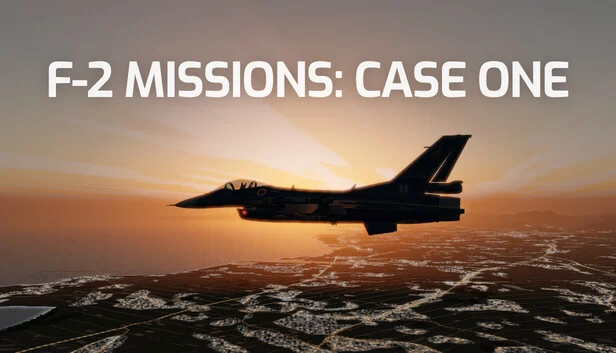
F-2 MISSIONS: CASE ONEF-2 MISSIONS: CASE ONE
REAL FLIGHT. REAL MISSIONS. FULL CONTROL. Strap into the F-2 and fly a full course of missions. One aircraft, the JASDF's F-2, over a true-to-scale Japan. Simple to pick up, and the flying is the real thing. Authentic flight model A flight model built on physics. Lift is computed from the aircraft's weight, speed and a…
REAL FLIGHT. REAL MISSIONS. FULL CONTROL.
Strap into the F-2 and fly a full course of missions. One aircraft, the JASDF's F-2, over a true-to-scale Japan. Simple to pick up, and the flying is the real thing.Authentic flight model
A flight model built on physics. Lift is computed from the aircraft's weight, speed and angle of attack, and every roll and pitch input turns into the turn performance those numbers allow at that instant. Holding a banked turn with back pressure is correct in the real jet, and it is correct here for the same reason.- Angle-of-attack based physics. Holding a banked turn with back pressure emerges from the equations, not a script
- Rate-command roll with no auto-leveling. Inverted flight is possible
- Control response scales with airspeed. The jet gets heavy when slow
- Structural g-limit. Pull past corner speed and the airframe, not a script, stops the stick
- A weight model based on the real aircraft. Drop tanks make it heavier, burning fuel makes it lighter a little at a time, and jettisoning the tanks makes it lighter all at once. Change the weight and the performance changes with it
- No stability assists, no auto-throttle. You manage speed and energy yourself, reading the HUD and instruments like a real pilot
The real skies of Japan
Real Japan, built from national survey data. Mountains, valleys, coastlines, lakes, inland seas, straits and rivers are all the real shapes. Airfields have the real number of runways pointing the real way. The Matsushima coastline, the Azusa valley and the ridges of Fuji are all exactly where they should be.Fuji is 3,776 m. The Kurobe gorge drops 1,800 m. Everything is true to scale, so the width of a valley and the speed at which a ridge closes in are what they would be in the real aircraft.
Surveyed building footprints, trees and far terrain are layered on the ground, and the sky is simulated from the atmosphere itself: time of day, cloud cover, rain, fog and wind. The same stage never feels the same twice, and at night a real star field comes out over the mountains.
The story: a year of special training
Set against joint training between Japan and the United States, F-2 MISSIONS follows the training of an F-2 fighter pilot. You are a rookie selected for a one-year special course. Home base is Matsushima. Beyond the training wait scramble alerts against unidentified aircraft, and a sky where the rounds are live.Your instructor is on the radio the whole way, telling you what to do next. You are never thrown into the sky without knowing what is expected.
The training course
It starts with takeoffs, circuits, turns and touchdowns, then moves on to low-level runs through real valleys, holding station behind a leader's wingtip, refueling from a KC-767, and landing on the deck of an allied carrier.- On low-level runs the real terrain is the puzzle. Stay under the radar, hide behind ridgelines, follow the river
- Every carrier landing is scored 0–100 on sink rate, centerline, wire and angle of attack, from calm daylight to crosswinds and moonlit night traps
Real-world missions: scramble
Sit alert, and launch when the bell rings. Join up with an unidentified aircraft, pull alongside to identify it by eye, and escort it until it turns back. You do not shoot. Once it is gone, fly home and land.Live-fire training: air, ground and sea
Down enemy fighters with guns and missiles, take out air-defense sites lining a valley, and strike a surface group beyond the horizon. The low flying you learned in training is what keeps you alive.- Guns only hit from behind. Firing from long range is a waste of rounds
- Lock before you fire a missile, and expect one back. Flares alone do not break a lock: you have to turn your exhaust away from the seeker
- A SAM site sees by line of sight. Crawl along the valley floor behind a ridge and it cannot lock you. Climb to take your shot and it sees you too
- Anti-aircraft guns cannot stop your approach, but they punish you for staying. Whatever you miss on the first pass means another lap through the flak
- Anti-ship missiles skim the waves. Fire from outside the escorts' umbrella, and drop to the sea if they fire back
- Your own aircraft takes damage too. Take enough hits and you go down trailing smoke
Cockpit view
A fully modelled first-person cockpit. The HUD is not a screen overlay: it is projected onto the combiner glass in front of you, so the symbology slides across the world as you turn your head. Your head is not bolted to the airframe. Every g the jet pulls goes through your neck, and catching a wire throws you forward in the straps. Read the meatball the way a pilot actually reads it: through the lens.Guide line and instructor on NORMAL
On NORMAL a guide line shows the path to the next gate as a ribbon: red when you are too fast, blue when you are too slow. Your instructor calls procedures and the next step over the radio, and says so, briefly, when you fly it well. On HARD and above the guide line disappears and the instructor says less. It does not get harder. It gets quieter.Replay every flight
Every flight is recorded from start to finish. Review your traps from the LSO's platform, a chase camera, the cockpit or a ridgeline spectator's view, then save the clip.Nothing flies the jet for you
Everything the real aircraft can do is in your hands. Assists live in the display, never in the controls. The FLOLS meatball, steering cues, gate rings and the guide line all show you where to go, and none of them fly the aircraft for you. What we simplified is the handling of the controls, not the flight.Difficulty, and beyond
- NORMAL / HARD / ACE. Difficulty rises through the environment (night, rain, fog, crosswind) and stricter judging. Clear NORMAL to open HARD, and ACE beyond it. On ACE you manage the landing gear yourself
- Progress you can measure. Every trap is scored 0–100 on sink rate, centerline, wire and angle of attack, so after every flight you know what was good and what was not
- FREE FLIGHT. Complete the course to unlock free flight: assemble your own sortie from scene, weather, wingmen and music, and fly with no clock and no score. The sky you get for graduating
Built for the desk
- Keyboard, gamepad (Xbox layout) and flight stick
- HDR output on HDR displays, uncapped frame rate, resolution and quality settings
- Windows and macOS (Apple Silicon)
- English and Japanese
After launch
- More mission types are planned
- VR support is planned as a free update
macOSWindows测试版本
CHEATS
游戏修改项
当前没有可用修改项
您仍可浏览游戏资料;如后续支持修改器,修改项会显示在这里。
DISCOVER MORE








评论