
← 返回游戏目录
So he goes into town.
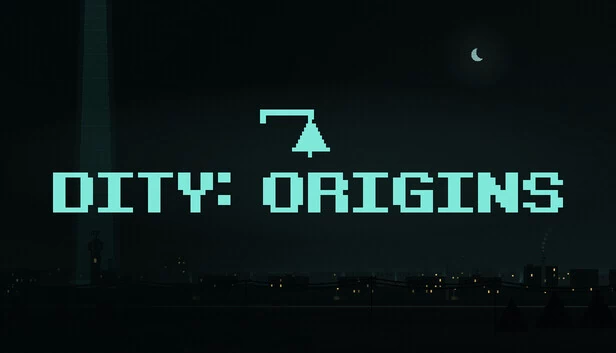
DITY: Origins is a single-player story adventure set in an open town. Hand-drawn characters in a three-dimensional world, pixel art. You walk where you like, talk to whoever you like, take work and live on what you earn. Eight chapters, around five hundred scenes, and a town that does not wait for you.
The whole game grows out of that. Every request sounds like a refusal, every conversation goes the wrong way, and the hero cannot work out why people look at him like that. Once he reaches town he picks up a great many words of native Ladogian — words they do not say back at the parish.
GAME PROFILE
DITY: OriginsDITY: Origins
They sent him out for soap Belian, Ladoga, autumn 1974. Bijan is a cleaner at a forest parish. He is twenty-four, he goes barefoot because the rule says so, and there is exactly one thing he is genuinely good at: washing floors. The parish has run out of soap. The town has soap. So he goes into town. DITY: Origins is a…
They sent him out for soap
Belian, Ladoga, autumn 1974. Bijan is a cleaner at a forest parish. He is twenty-four, he goes barefoot because the rule says so, and there is exactly one thing he is genuinely good at: washing floors. The parish has run out of soap. The town has soap.So he goes into town.
DITY: Origins is a single-player story adventure set in an open town. Hand-drawn characters in a three-dimensional world, pixel art. You walk where you like, talk to whoever you like, take work and live on what you earn. Eight chapters, around five hundred scenes, and a town that does not wait for you.
A language you cannot make a deal in
In Ladogian a polite negation is a yes: “don’t worry, I won’t help you” means “I will.” That is how Bijan speaks. Everyone hears a refusal.The whole game grows out of that. Every request sounds like a refusal, every conversation goes the wrong way, and the hero cannot work out why people look at him like that. Once he reaches town he picks up a great many words of native Ladogian — words they do not say back at the parish.
What you actually do
- Walk the town. On foot or by town bus: it runs to a timetable, and you get on it yourself, not only when the plot says so. 17+ districts: the railway station, the park, the school, the building site, the cottage estate outside town — and whatever you reach on your own.
- Go inside. 20+ interiors, each furnished in its own right: up the stairs, down into a cellar, behind the bar.
- Talk. More than a thousand lines of dialogue and thirty-six branches. You choose what to say, and every option shows what unlocked it: luck, strength, money, something in your pocket, or something you have already done.
- Earn. Bijan has no money of his own at all: the cints are his to make. There is more than one kind of work in town — cleaning, for one.
- Keep a journal. One button: your current goal, what is done, and who is waiting on you.
Luck, strength and cints — the second storyline
There is no levelling here in the usual sense. Three counters run alongside the plot: cints, luck and strength. Bijan comes to town and earns every bit of it himself, from nothing.- Out of luck — the price in the shop goes up, the dice fall for the other man, and the best lines in a conversation simply never occur to Bijan: they are not on the list. This is not a miss chance; these are replies you will never see.
- Out of strength — your opponent stays on his feet longer, the work can't be worked off. Run out entirely and Bijan sits down where he stood and falls asleep in the middle of the cleanest town in the country. He can wake up without what was in his pockets.
15+ mini-games and pastimes
These are not interludes between scenes, they are the scenes: nearly every one is a branch, and playing one badly sends the story somewhere else. These are the ones you cannot walk past:- Cleaning — bucket, rag, an area and a strip of clean floor.
- Fighting — three buttons: strike, guard and the open palm. You do not hit with the palm, you walk out of the fight with it, and that is an outcome of its own.
- Dice — two dice, three rolls, your stake.
- The one-armed bandit and J. Moorkey's table — the very slot machine from the DITY universe, and Russian roulette.
The town runs itself
- Townspeople walk to work and home again, ride the bus and their own cars, lie about in the street and patrol the block. Their day does not begin when you arrive.
- Cars drive, the bus runs its route, and there are trains standing at the station.
- There is a dog you can follow. It really is going somewhere.
A second story you are not in
The Belian Herald comes out regularly and every issue is readable end to end — not headlines, full articles. The town's own story runs through it: a shopping centre eight years under construction, rats in the quarter by the station, and an out-of-town property buyer the paper declines to name. You are not in those articles. That story runs whether you read it or not.8+ endings
The ending is not decided in the last five minutes. It is assembled out of the choices you make in conversation, the obligations you take on and drop, what is in your pocket on the final day, and whether Bijan is still himself. Each ending has its own finale.What's in the game
- A prologue, 8+ chapters and an epilogue: about 500 scenes, 1000+ lines, 36+ branches
- 8+ endings
- 15+ mini-games and pastimes
- 17+ districts of an open town, 20+ interiors you can enter
- 14+ achievements
- 14+ music tracks, its own ambience for every place, 19+ characters with a voice of their own
- Fully translated: English, Russian, German, Spanish
- Three save slots
linuxmacOSWindows测试版本
CHEATS
游戏修改项
当前没有可用修改项
您仍可浏览游戏资料;如后续支持修改器,修改项会显示在这里。
DISCOVER MORE



评论